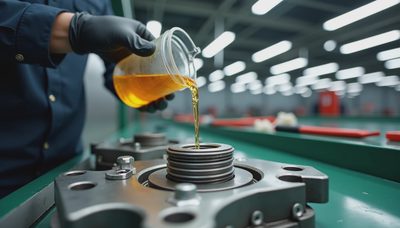
Choosing the right industrial lubricant can double component life and save tens of thousands in downtime
Why This Matters (cost/safety/longevity payoff)
Picking “whatever grease is on the shelf” is how perfectly good bearings, chains, and bushings get eaten alive by wear and corrosion. The right industrial lubricant does three money-saving things:
- Maintains an oil film (a protective layer that separates metal parts) to cut friction and heat.
- Prevents corrosion when water, humidity, or washdowns are part of daily life.
- Handles load and shock so parts survive vibration and extreme pressure instead of scuffing and pitting.
The source gives a real-world payoff: in a copper ore mining operation, switching to a lubricant with a corrosion inhibitor and extreme pressure additives doubled chain life, boosted primary crusher production rates by 30%, and saved $40k US annually. That’s the kind of return you get when lubrication is treated like a reliability strategy, not an afterthought.
What You Need to Know (specs, types, intervals)
Start with the manufacturer’s recommendation, but don’t stop there. Manuals are typically written for “ideal conditions,” and your equipment rarely lives in ideal conditions.
The “4 C’s to Lubrication”
The source recommends building your lubrication program around these four basics:
1. Correct Technology (right lubricant type and formulation)
2. Correct Quantity (not too much, not too little)
3. Correct Frequency (service intervals that match your conditions)
4. Correct Procedures (how you apply and handle the lubricant matters)
One example spec from the source: NLGI-grade #2 grease
If your equipment manufacturer calls for NLGI-grade #2 grease (a common grease consistency grade—think “how stiff the grease is”), that’s a starting point. But the source calls out a key reality check: if you’re operating in below zero conditions, the “book” grease may not be the best real-world choice.
What controls lubricant choice (the big six)
To select the right lubricant, evaluate your actual operating environment:
- Speed
- Temperature
- Load
- Vibration
- Moisture
- Dust
And use these rules from the source:
- Temperature determines lubricant base oil type
- Speed determines viscosity required (at operating temperature)
- Load, vibration, and moisture determine the additive package
Lubricant classifications (from the source)
Industrial lubricants fall into three broad categories:
1. Fluid (Liquid)
2. Semi-Solid (Grease)
3. Solids (Dry)
What grease actually is
Grease isn’t just “thick oil.” Per the source, grease is made up of:
- Oil base stock
- Thickeners
- Functional additives (ingredients added to enhance performance)
Common, lower-cost grease building blocks include mineral oils as base stocks and lithium/lithium complex thickeners. They’re frequently used because they’re cheaper, but the source notes they do not offer the same performance as a synthetic base grease.
Pro Tip: When you’re comparing greases, don’t get fixated on only the NLGI grade. Two NLGI #2 greases can behave very differently depending on base oil type and the additive package.
How It Works (a practical selection process you can follow)
Here’s a step-by-step way to apply the source’s logic on your equipment.
Step 1: Start with the OEM recommendation—then reality-check it
Use the manufacturer’s recommendation as your baseline (again, the source explicitly supports this), but ask:
- Are you running below zero?
- Is there constant water contact or washdown?
- Is the area loaded with dust?
- Is there heavy vibration or shock loading?
If the real conditions are harsher than “ideal,” you may need a different lubricant technology or additive package.
Step 2: Identify what the application is trying to survive
Use the source’s mapping:
- High temperature → prioritize the correct base oil type
- High speed → ensure the right viscosity at operating temperature
Viscosity means a fluid’s resistance to flow—in plain terms, how thick it is at a given temperature.
- High load / vibration / moisture → choose the right additives
The goal is always the same: maintain a sufficient film layer of lubrication to reduce friction and protect surfaces.
Step 3: Match the additive package to the problem
The source emphasizes that the additive package has a significant impact on performance. Two key examples it gives:
- If a bearing will see significant water contact, choose a lubricant with:
- Low-water washout (it won’t rinse away easily)
- High-corrosion resistance (it protects metal from rusting)
- If bearings operate at low speeds and extreme pressure, reliability can improve by selecting:
- Higher base oil viscosity lubricant
- High-load capabilities
Pro Tip: Low speed is sneaky. People assume “slow” means “easy,” but the source points out low speed + extreme pressure can demand higher base oil viscosity to keep a protective film in place.
Step 4: Understand viscosity drop with heat and speed
The source notes that as temperatures or speeds increase, viscosity decreases. Translation: the lubricant gets “thinner” in operation, and a thin lubricant can fail to maintain the protective film you need.
So you’re not choosing viscosity based on room temperature—you’re choosing it based on operating temperature, as the source states.
Step 5: Plan ahead for aggressive environments
If you work in places like a mine, the source highlights typical conditions: high moisture, corrosion, and extreme temperatures. In these environments, the lubricant must:
- Maintain a sufficient lubricating film
- Resist load and wear
- Prevent corrosion
Step 6: Apply the mining case study logic to your own equipment
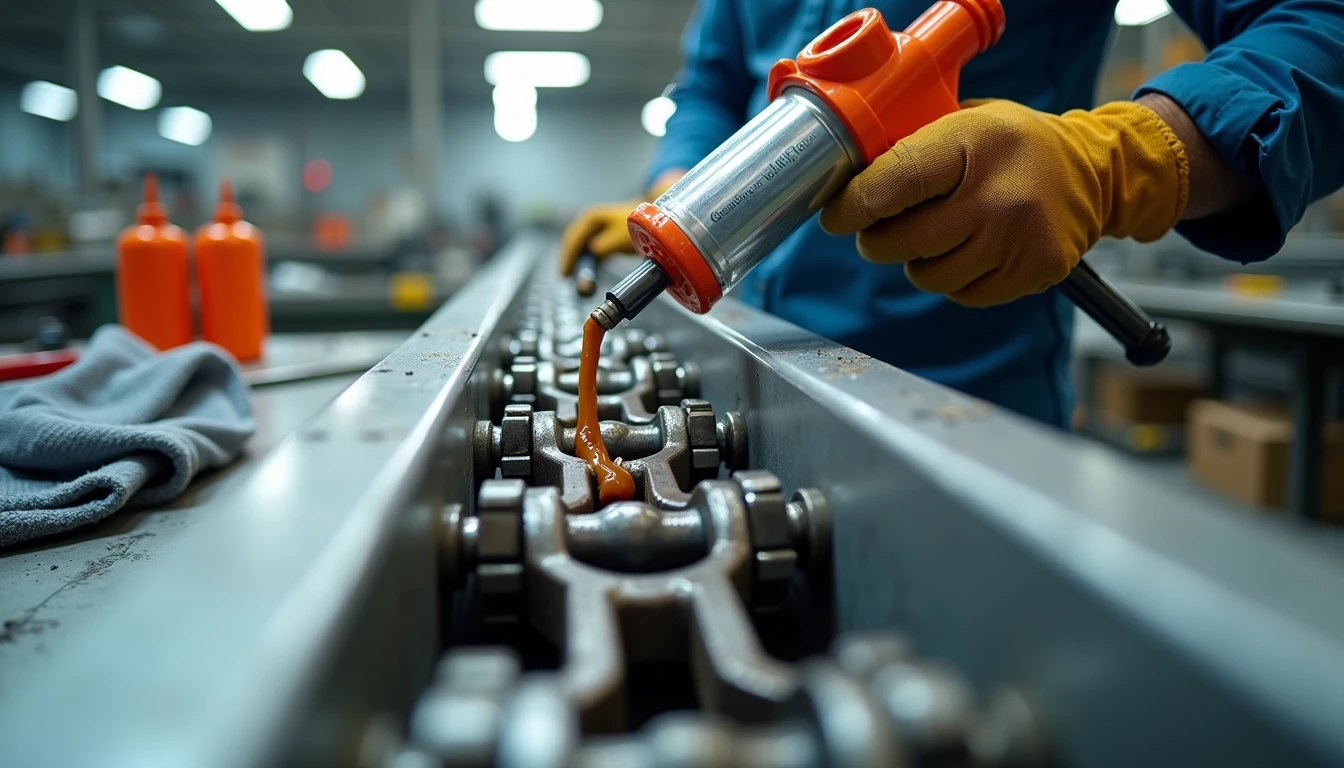
In the source’s case study, an apron feeder chain was exposed to constant moisture and dirt, leading to water/dust residue, wear, and corrosion in the pin and bushing. The fix was switching lubricants to one with:
- A corrosion inhibitor
- Extreme pressure additives
…and a product that could penetrate the pin and bushing, reduce debris buildup, and keep parts corrosion-free.
Use that same logic anywhere you have pins, bushings, chains, or bearings living in wet grit: you’re not just lubricating—you’re fighting contamination and corrosion.
Common Mistakes (myths, pitfalls, warnings)
Mistake 1: Assuming the manual covers your real operating conditions
The source is blunt: manuals are written for ideal conditions and may not address your actual environment. If you’re running below zero, wet, dusty, or vibrating heavily, you need to select for those conditions.
Mistake 2: Ignoring the additive package
Base oil and thickener matter, but the source stresses additives can make or break performance—especially when moisture, load, and vibration are involved.
Mistake 3: Forgetting that heat and speed thin the lubricant
Because viscosity drops as temperature or speed rises (per the source), a lubricant that seems “thick enough” cold can be too thin in operation, reducing film strength and increasing wear.
Mistake 4: Choosing grease by cost alone
The source notes mineral oil and lithium/lithium complex greases are lower cost and widely used, but don’t match the performance of a synthetic base grease. Cheapest up front can become the most expensive once you factor in parts wear and downtime.
Mistake 5: Over- or under-greasing
The source begins to introduce the damage from incorrect greasing quantity and frequency. Even without the missing remainder, the takeaway is clear: quantity and frequency are not optional details—they’re part of doing lubrication correctly.
Pro Tip: Treat grease like a measured maintenance input, not a “pump until you see it ooze” habit. Correct quantity and frequency are core to the source’s 4 C’s.
Bottom Line (summary, recommended action)
Industrial lubricant selection is about matching lubricant technology, viscosity at operating temperature, and additives to your real environment—speed, temperature, load, vibration, moisture, and dust. Start with the OEM recommendation (including specs like NLGI-grade #2 grease when applicable), but adjust for harsh conditions. Done right, it can dramatically extend component life—as shown by the source’s mining case where chain life doubled and annual savings hit $40k US.