If you've ever had a customer come in with a check engine light and a lean code, the Mass Air Flow (MAF) sensor is one of the first components you'll check. Understanding **how does a MAF sensor work** is essential for accurate diagnosis and customer trust. This sensor tells the engine control unit (ECU) exactly how much air is entering the engine, so the ECU can calculate the correct fuel mixture. Without a properly functioning MAF, the engine runs rich, lean, or stumbles—and you get a frustrated driver. Let's break down the inner workings, the types you'll encounter, and what to do when one goes bad.
The Basic Principle: How Does a MAF Sensor Work?
At its core, a MAF sensor measures the mass of air flowing into the engine per unit time. The ECU needs this value to determine injector pulse width. The most common design is the hot-wire anemometer. A thin platinum wire is heated to a constant temperature (typically about 200°C above the incoming air temperature). As air flows past the wire, it cools it down. The sensor electronics increase the current through the wire to maintain the set temperature. The amount of compensating current is directly proportional to the air mass flow. That signal—measured in volts or frequency—goes to the ECU. This is the fundamental answer to **how does a MAF sensor work**: it uses electrical current to keep a wire hot, and the current needed tells the ECU the air mass.
Another variant is the hot-film sensor, which uses a heated ceramic or silicon substrate instead of a wire. It works on the same principle but is more durable and less prone to contamination. Both types output a signal that the ECU interprets under various load conditions. The key takeaway: a MAF sensor is a precision airflow meter, not just a flow switch.
Types of MAF Sensors and Their Operation
Two main types dominate the aftermarket and OEM world: the hot-wire MAF and the hot-film MAF. Each has its own operating characteristics and failure modes.
**Hot-wire MAF:** Found on many European and Asian vehicles from the 1990s through 2010s. The platinum wire is exposed directly to the intake air. Because it's exposed, it can become coated with dirt, oil, or silicon from certain air filters. When contaminated, the wire's thermal conductivity changes, causing the sensor to underreport or overreport airflow. This is why cleaning with a specific MAF cleaner (not brake cleaner) can restore function.
**Hot-film MAF:** Common on newer domestic and Asian vehicles. The heating element is embedded in a protective film, making it more resistant to contamination but less accurate at very low flows. Some hot-film sensors use a frequency output instead of a voltage signal. The ECU interprets the frequency as airflow. Understanding **how does a MAF sensor work** differently between these types helps you choose the right diagnostic approach. For example, a voltage-driven hot-wire sensor should read around 0.5–1.0V at idle and up to 4.5–5.0V at wide-open throttle. A frequency-driven sensor might output 30 Hz at idle and 150 Hz at full load.
Common MAF Sensor Failure Symptoms and Diagnosis
A failing MAF sensor often mimics other issues. Here are the typical complaints you'll hear:
- Check Engine Light on with codes like P0100-P0103 (MAF circuit range/performance)
- Rough idle, stalling, or hesitation on acceleration
- Black smoke from exhaust (rich mixture) or lean misfire codes
- Poor fuel economy and failed emissions tests
The diagnostic process starts with scanning the ECU for codes, then graphing the MAF signal with a scan tool. At idle, a healthy sensor should show stable airflow (grams per second) within ±1 g/s of the specification for that engine. If the signal is erratic or stuck at a fixed value, the sensor is likely bad. A quick check: tap the sensor gently while monitoring the reading—if it jumps, the internal connections are failing. Remember that even a seemingly clean sensor can be faulty, so always verify by plotting the signal against engine RPM and load.
Cleaning or Replacing a MAF Sensor
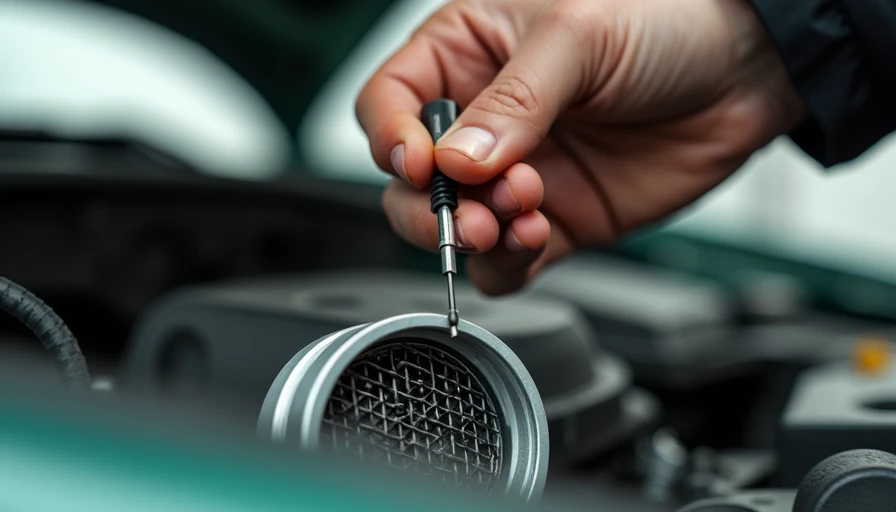
Before condemning a MAF sensor, try cleaning it if it's a hot-wire type. Use only a dedicated MAF sensor cleaner—never carburetor cleaner or alcohol, which can damage the delicate wire or film. Remove the sensor from the intake duct (careful with the O-ring), spray the wire or film from a distance of about 6 inches, let it dry completely, and reinstall. This resolves about 30% of MAF-related complaints. If cleaning doesn't fix the issue or the sensor is a hot-film type that's physically damaged, replacement is necessary. Always use an OEM or reputable aftermarket sensor—cheap no-name sensors often have incorrect calibration and can cause drivability problems.
Reference Box: The typical MAF sensor output at idle is 3–7 g/s for a 4-cylinder engine and 5–10 g/s for a V8. If you see 0 g/s or >15 g/s at idle, start your diagnosis here.
Conclusion
Whether you're a technician diagnosing a tricky lean code or a DIY owner trying to understand that service manual, knowing **how does a MAF sensor work** gives you a clear path to the fix. The hot-wire and hot-film designs are both reliable, but they fail in predictable ways. When a customer asks the one-line answer: "The MAF sensor heats a wire or film, measures how much current it takes to keep it hot, and sends that signal to the computer. If it's dirty or broken, the computer gets wrong data." Here's the chemistry, here's the spec, here's what to do with it.




No comments yet — be the first to share a thought.