If a car idles rough, stumbles on acceleration, or sets codes like P0101, one of the first components on the bench is the mass air flow sensor. This guide covers how to test mass air flow sensor using a digital multimeter and a scan tool, what the readings should look like, and when cleaning only delays the replacement. By the end you will know how to separate a bad MAF from a vacuum leak, a clogged air filter, or a wiring problem. Here's the chemistry, here's the spec, here's what to do with it.
Symptoms That Point to the MAF Sensor
A failing mass air flow sensor can show up in several ways. The most common complaints are a rough idle, hesitation when you press the gas, black smoke from an over-rich mixture, or a check-engine light with codes in the P0100 to P0103 range. The MAF sensor is the computer's eyes on the incoming air. When the signal drifts, the air/fuel mixture drifts with it, and fuel economy takes a hit.
These symptoms overlap with other failures. A vacuum leak, a weak fuel pump, or a restricted exhaust can all mimic a bad MAF. That is why it pays to test the sensor itself before replacing parts. You can learn how to test mass air flow sensor in about fifteen minutes and avoid throwing an expensive part at a problem that was never there.
Tools and Setup for a Clean Test
You need three tools: a digital multimeter, a scan tool with live data, and the vehicle's factory service manual. For most cars, that is all. Skip the parts-cannon approach and start with a cold inspection.
Park the vehicle on level ground, set the parking brake, and let the engine reach operating temperature. If the air filter is choked with dirt, change it first. A restriction upstream of the MAF alters the airflow reading and can make a good sensor look bad.
Reference Box: MAF sensors measure mass flow, not just volume. The engine computer uses that mass reading to calculate fuel delivery. The spec that decides whether the sensor is good is the signal output at idle and at a snap throttle.
How to Test Mass Air Flow Sensor: Step by Step
Start with the visual check. Pull the intake duct off the MAF housing and inspect the sensing element. On a hot-wire MAF, it is a thin wire or film inside the air path. Look for dirt, oil film, or debris. An over-oiled aftermarket air filter can coat the wire and make the signal sluggish. If the element is contaminated, you may be able to clean it, but test it first.
Next, unplug the electrical connector and inspect the terminals. Bent pins, green corrosion, or a loose terminal will cause intermittent faults. Reconnect the connector firmly and clear any stored codes.
This is the actual electrical test. Connect your scan tool to the OBD-II port and read the mass airflow in grams per second with the engine at warm idle. As a rough starting point, a 2.0L four-cylinder typically shows 3 to 6 grams per second. A 5.7L V8 often idles between 6 and 10 grams per second. If the screen reads zero, jumps around, or stays locked on one number, the sensor signal is not credible.
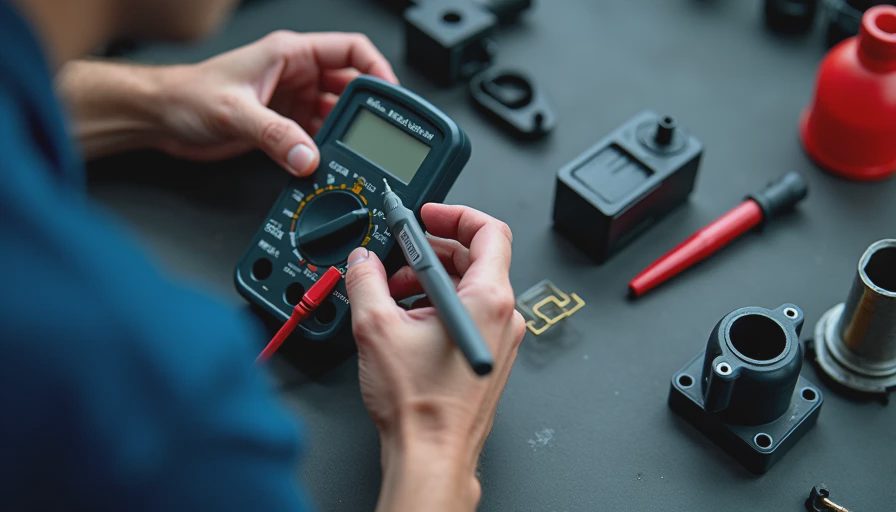
Now back-probe the signal wire with the multimeter set to DC volts. On most analog-output MAF sensors, idle voltage sits near 0.6 to 1.2 volts. Open the throttle to about 2,500 RPM and the voltage should climb to somewhere around 2.5 to 3.5 volts, then settle back smoothly when you release the pedal. If the voltage lags, spikes, or hangs high, replace the sensor. Vehicles with frequency-based MAF sensors give the expected range in Hertz in the service manual; use the same throttle-snap method.

What the Numbers Tell You
If the gram-per-second reading and voltage both respond cleanly, the MAF sensor is likely not your problem. Move on to smoke-testing for vacuum leaks or checking fuel pressure. If the readings are off but the element looks dirty, try a cleaner made specifically for MAF sensors. Spray the element from a distance, let it air dry, and do not touch the wire. Brake cleaner is too aggressive and can destroy the sensor.
Cleaning fixes an oily film, but it does not fix dead electronics. If the sensor is unresponsive, no amount of solvent will bring it back. A factory replacement can cost anywhere from $150 to $400 depending on make and model. Aftermarket units often run $60 to $150, but skip the unknown brand with no return policy; the calibration can be far enough off to cause a comeback.
Once you know how to test mass air flow sensor this way, it is the same procedure on almost every vehicle. The exact voltage or frequency varies, but the method does not. That consistency is why it belongs in every technician's diagnostic routine.
Common Mistakes to Avoid
The most common mistake is testing the sensor without a warm engine. Cold readings change the calibration and can make a good sensor look bad. Another is using a scan tool that only displays codes rather than live data. You need the live grams-per-second screen.
Do not clean the sensor while it is installed. Remove it from the duct, spray the element, and let it fully dry. Also, do not use compressed air on the element; the air can snap the wire. Finally, check the wiring harness before condemning the sensor. A rubbed wire or a bad ground can produce the same codes.
If your customer asks, the one-line answer is this: a MAF sensor test is a visual check, a live data check, and a voltage check. Those three steps tell you whether to clean, replace, or move on to the next system.

No comments yet — be the first to share a thought.