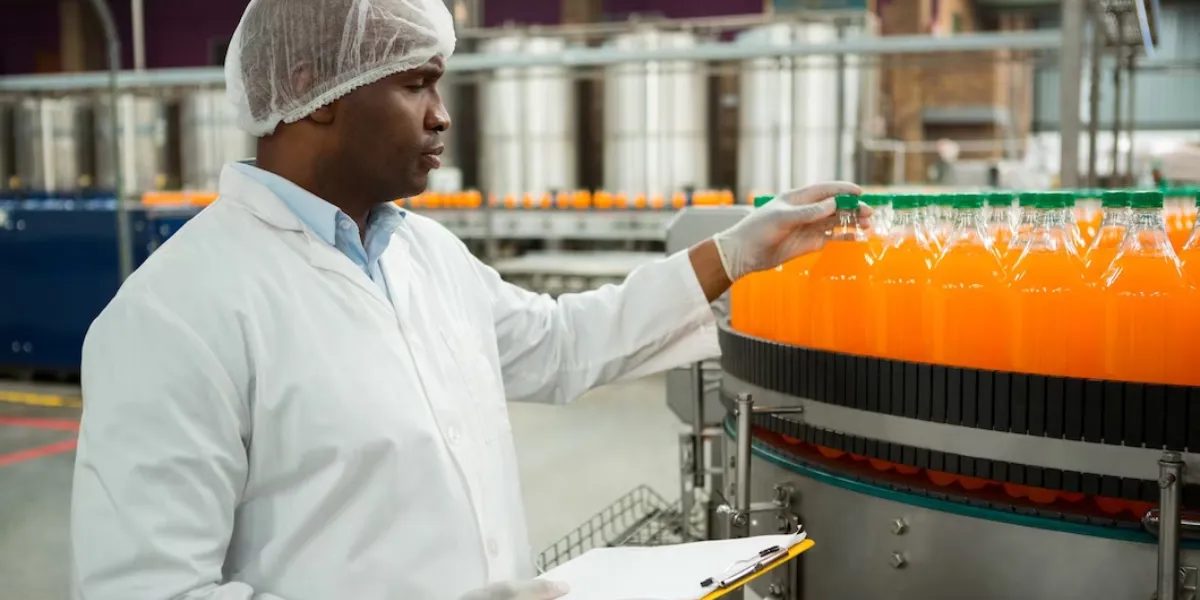
Food and beverage manufacturers operate under hygiene and cleanliness expectations as demanding as those found in medical facilities or fine dining establishments. Every piece of equipment on the production floor must meet these same rigorous standards. Combined with disciplined maintenance routines, manufacturers can continue delivering food that is both safe and enjoyable. The lubricants and maintenance practices chosen for this equipment directly influence operational efficiency, machine performance, and the overall safety of the facility.
Any operation producing food or beverages is required to rely exclusively on food-grade lubricants as part of its maintenance program. In these settings, selecting the wrong lubricant for a given application creates risks far beyond simple performance degradation. Depending on the situation, incorrect lubrication can trigger contamination events, force production halts, or even necessitate costly product recalls that threaten the long-term viability of the business.
Whether caused by misapplication, improper storage, or an accidental spill on the factory floor, lubricants have the potential to contaminate food products. It is essential to recognize that lubricants will affect any product or surface they encounter, which makes the exclusive use of food-grade lubricants a non-negotiable priority rather than an optional consideration.
The following overview covers industrial lubricants used in food processing equipment, along with the critical ways they protect both consumer safety and product quality.
Preventing equipment failures, maximizing machinery lifespan, and limiting production downtime are the core objectives of any maintenance program. Food manufacturing environments subject equipment to extreme conditions including moisture, freezing temperatures, intense heat, mechanical shock, and continuous round-the-clock operation. Routine lubrication of gears, bearings, and chains is therefore essential for guarding against corrosion, oxidation, friction, and progressive wear.
Reputable facilities maintain detailed maintenance schedules that document every procedure, recording specific dates and times for each service. These records help maintenance teams reduce the risk of lubricant contamination and foreign object incidents while upholding the operational safety of the entire facility. A well-structured lubrication management program can push food safety compliance beyond the bare minimum, achieving not only mandatory but also best-practice standards at every stage of production.
One powerful approach to reaching the highest food industry safety benchmarks is enrollment in the Valvoline Fluid Analysis Program. A comprehensive maintenance and fluid analysis program gives facility managers the tools to assess and continuously improve every dimension of production.
The foremost obligation of any food manufacturer is delivering products that consumers can trust. Meeting that obligation demands rigorous safety management carried out on demanding timelines. It is well understood that elevated production volumes increase both the likelihood of human error and the probability of equipment malfunction.
Key safety concerns associated with food processing equipment lubricants include the following:
The overwhelming majority of modern food production relies on automated machinery. Preparation, processing, and assembly all depend on mechanical operations such as cooking or chopping. Although direct contamination through lubricants is statistically uncommon, maintaining the careful balance between contamination risk and proper equipment function remains an ongoing imperative.
As an example, a blade in a dicing or slicing station that is improperly maintained or installed can fracture and introduce metal fragments into the food stream. Even if the blade itself carries no lubricant, poor maintenance practices may have caused the malfunction that led to contamination. Conversely, in mixing operations, incorrect lubricant application can directly introduce contaminants through the rotating components of the mixing unit.
Facilities producing vegetarian, vegan, or allergen-free products carry an additional obligation to verify that every lubricant and maintenance chemical used on-site aligns with the product's label claims. In particularly stringent cases, manufacturers may be required to submit lubricants for independent testing to confirm the complete absence of allergen contamination risks.
All cleaning agents used in maintenance and sanitation must carry appropriate approvals. Within the food industry, customer-imposed chemical approval lists often go beyond regulatory minimums. After cleaning mixing vessels, storage tanks, water tanks, and food silos, rinse water is tested to confirm full removal of cleaning solution residues. The inspection process concludes with the application of food-grade oils and greases to restore proper machinery function.
Equipment that has accumulated years of service has undergone correspondingly more maintenance interventions, and each additional service event introduces new potential complications. Older machinery may require more frequent disassembly, inspection, and relubrication than newer units. Greater maintenance frequency translates directly into elevated contamination risk from lubricants and related materials.
Contamination risk is typically highest during line changeovers and start-ups, when production lines must be fully cleaned and serviced before new runs can begin. During these intervals, maintenance personnel apply lubricants and greases throughout the line, all of which must carry food industry approval wherever incidental contact with food is possible.
Food-grade oils and lubricants undergo thorough evaluation by independent testing bodies. Earning classification as suitable for food production requires a lubricant to be certified as safe for use where contact between food and lubricant is a possibility. At the same time, these lubricants must deliver lubrication performance equivalent to conventional industrial lubricants used in non-food sectors.
Food-grade lubricants are expected to defend against wear, friction, oxidation, corrosion, and degradation, while also facilitating effective power transfer and heat dissipation. They must resist chemical breakdown, withstand exposure to water and steam, and remain chemically inert toward plastics and elastomers. Reliable performance under extreme conditions—including high and low temperatures, dusty environments, and exposure to bacteria and fungi—is likewise a mandatory characteristic.
Beyond technical performance, food-grade lubricants must carry NSF certification. The NSF is an internationally recognized organization dedicated to advancing public health through standard-setting, independent testing, and product certification. For lubricants used in food production, NSF certification confirms that the product has been properly evaluated and is safe in scenarios involving incidental food contact. The NSF permits a maximum concentration of 10 parts per million (ppm) in food-grade lubricants for such incidental contact.
Three categories of food-grade lubricants are currently in use. This classification system was originally developed by the United States Department of Agriculture and continues to be followed by all lubricant manufacturers in the industry.
H1 lubricants are designated for use in areas where food is prepared, processed, or packaged and where lubricant contact with food is a realistic possibility. These lubricants may only be formulated using approved base stocks, additives, and—in the case of greases—approved thickeners. They are also entirely free of taste and odor. H1 grease is appropriate for lubricating pumps, belts, and mixers, and finds application across canning, cooking, cutting, handling, and brewing operations.
H2 lubricants are permitted in food industry settings but are restricted to equipment and machinery components where food contact is categorically impossible. Because contamination risk is eliminated in these applications, H2 lubricants may be formulated from a considerably broader range of ingredients. However, they are still prohibited from containing heavy metals such as antimony, arsenic, cadmium, mercury, or lead, and all components must be non-carcinogenic and free from mutagens, mineral acids, and teratogens.
H3 lubricants, more commonly referred to as edible or soluble oils, serve primarily in cleaning and protective applications. They are frequently applied to trolleys, hooks, conveyor belts, and similar equipment.
Not every machine in a food manufacturing facility necessarily requires food-grade lubrication. However, identifying which machines do require it is a more nuanced exercise than it might appear. A conveyor belt traveling directly above a food line, for instance, clearly demands H1 lubricants, whereas a belt running below the food line may not carry the same requirement.
The only strategy that eliminates all ambiguity is defaulting to NSF/H1 certified food-grade grease or oil for every application. H1 food-grade oils protect machinery from oxidation, corrosion, friction, and wear-related damage throughout normal operation. Despite working within a restricted pool of approved additives and base stocks, food-grade lubricants provide robust protection—in some instances outperforming their non-food-grade counterparts.
The HACCP program recommends conducting a thorough evaluation of every individual lubrication point in the facility. Given that the majority of food production companies in Europe operate under HACCP standards, taking lubrication decisions seriously is not optional. Suppliers like Valvoline are well-positioned to assist through lubrication surveys and detailed technical guidance. If questions arise about which Valvoline product best matches a specific production stage or condition, our knowledgeable team and the Lubricant Advisor tool are available to help ensure both maximum safety and optimal lubrication performance.
For any manufacturer who remains uncertain about the consequences of using improper food processing lubricants, real-world examples offer sobering perspective. In 1998, Smithfield Foods was compelled to recall more than 225,000 kilograms of ham after the product was declared contaminated. Non-food-grade lubricant contamination prompted consumer reports of an unpalatable taste along with health complaints including throat irritation.
Two years later, in 2000, Farmland Foods recalled 39,000 kilograms of sliced turkey following lubricant contamination. Consumers in that incident reported unusual odors and flavors in the meat, with some individuals experiencing gastrointestinal discomfort. The financial damage sustained by both companies underscores why the use of food-grade oils throughout the production process is indispensable for preserving brand reputation.
When contamination incidents involving non-food-grade lubricants occur—particularly those requiring product recalls—businesses face consequences that extend well beyond immediate financial loss. Brand equity erodes, consumer trust diminishes, and lasting harm to the business can follow. Additional costs arise from production downtime and the effort required to establish new contracts with lubricant suppliers. Taken together, investing in food-grade lubricants from the outset is the only rational choice for food manufacturers. Relying on lubricants that are not approved for food production will almost certainly attract scrutiny from inspectors and auditors following any food safety incident.
With more than 150 years of history in the lubricant industry, Valvoline has earned its standing as a leading name in the field. Every product we offer is developed, tested, and continuously refined to deliver outstanding performance and straightforward application. Food-grade products such as Food Calsul and Food Alucom carry NSF certification and satisfy all lubrication requirements for use in food processing environments. In addition to our food-grade range, Valvoline covers the full spectrum of oil, grease, fluid, and specialty product needs.
A proactive approach to machinery maintenance—selecting the right product for every application at every stage of production—is always the superior strategy. With appropriate industrial lubrication, product contamination can be effectively prevented and maintenance can be carried out to a high standard. This gives manufacturers genuine confidence in their production integrity and the safety of the consumers they serve, both of which are foundational to sustained business success.
Forward-thinking food processing businesses recognize that the investment in food-grade lubricants is not a cost to be minimized but a strategic decision that pays dividends. By specifying H1 lubricants suited to food industry conditions, facilities can reduce contamination incidents, limit unplanned downtime, and strengthen overall processing capacity. When the lubricant is properly matched to the application and operating environment, production flows efficiently and the company's reputation for quality remains firmly intact.



No comments yet — be the first to share a thought.