This guide explains what you will be able to look up quickly: how an EGR valve works, why deposits cause trouble, which symptoms point toward an actual fault, and when cleaning is sensible. The EGR valve is an emissions-control component, but its operation is tied directly to combustion temperature, intake airflow, engine oil contamination, and coolant temperature. Here is the chemistry, here is the spec, here is what to do with it.
What the EGR valve does
An EGR valve routes a controlled amount of exhaust gas back into the intake stream. That gas contains very little oxygen, so it displaces some of the fresh air that would otherwise enter the cylinder. The resulting mixture burns at a lower peak temperature. Lower combustion temperature reduces formation of oxides of nitrogen, commonly called NOx.
The system is not intended to recirculate exhaust constantly. The engine control module uses load, speed, coolant temperature, throttle position, manifold pressure, and sometimes an exhaust-pressure sensor to decide when flow is useful. At idle, many systems keep the valve closed because exhaust dilution can make the engine unstable. During light or moderate cruise, the valve may open. During heavy acceleration, it generally closes so the engine can receive maximum fresh charge.
Older applications commonly use vacuum-operated valves. Newer vehicles often use electronically controlled valves with a position sensor. Some diesel engines use high-pressure and low-pressure EGR circuits, with coolers, bypass valves, and differential-pressure sensors adding more diagnostic possibilities. SAE J1930 terminology is useful when reading service information because it standardizes many powertrain component names, but the manufacturer's test procedure remains the deciding authority.
Reference Box: The EGR valve lowers NOx by replacing part of the incoming oxygen-rich charge with inert exhaust gas. It is not an intake-cleaning device and it does not improve power when open at full load.
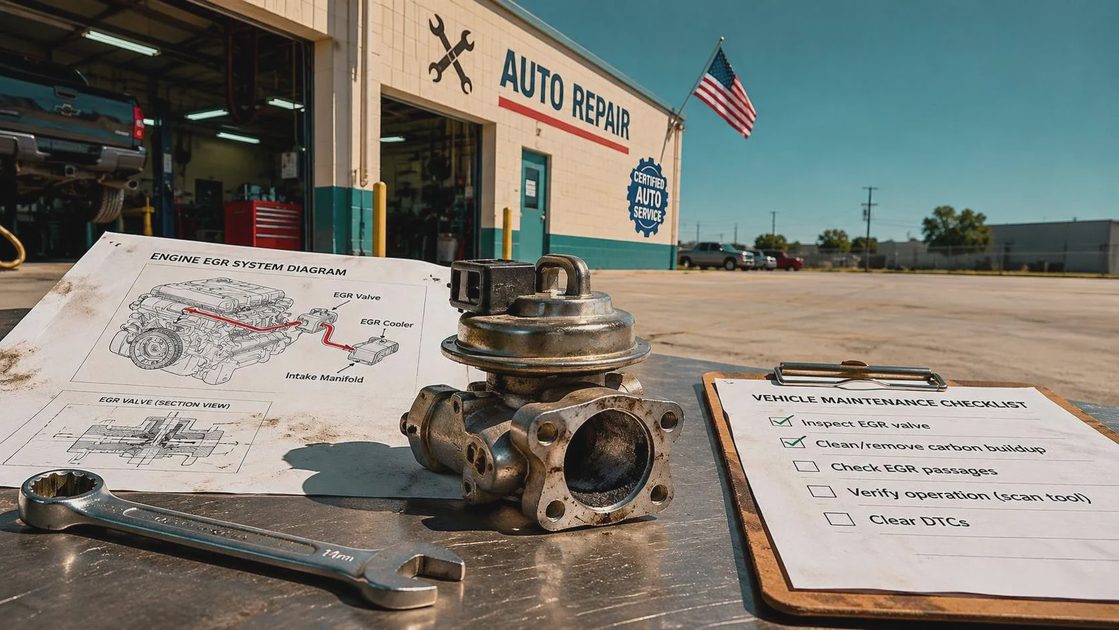
EGR valve failure symptoms
A stuck-open EGR valve can produce rough idle, stalling, hesitation just off idle, or a hard start. The engine is receiving exhaust dilution when it needs a stable fresh-air charge. A stuck-closed valve may produce no obvious drivability complaint at first, but it can trigger an emissions fault, increase combustion temperature, and contribute to a failed inspection where emissions testing applies.
Common diagnostic trouble codes include P0400 for an EGR flow problem, P0401 for insufficient flow, and P0402 for excessive flow. These codes identify what the control system observed, not automatically which part must be replaced. A restricted passage can set P0401 even when the valve motor works. A leaking vacuum hose, faulty solenoid, blocked cooler, damaged wiring, or inaccurate pressure sensor can create the same code family.
Other clues include a check-engine light, reduced fuel economy, diesel surge, black smoke, or an engine that runs better when the EGR command is disabled during a controlled scan-tool test. Do not treat one symptom as proof. A vacuum leak, throttle-body fault, ignition problem, or mass-airflow sensor error can imitate an EGR problem.
How to diagnose the EGR valve
Begin with a visual inspection. Look for cracked vacuum tubing, loose electrical connectors, corrosion, damaged harness insulation, carbon tracks, and soot around a flange or cooler. On a vacuum-operated EGR valve, apply the specified vacuum with a hand pump and watch whether the actuator holds it. If the vacuum falls quickly, the diaphragm or hose circuit leaks. If the engine does not react when the valve opens, the passage may be blocked or the valve may not be moving internally.
For an electronic EGR valve, use a scan tool capable of displaying commanded and actual position. A healthy system should show the two values responding in a reasonable relationship, although the exact voltage and percentage depend on the vehicle. Back-probing circuits without a wiring diagram can damage terminals or short a reference circuit, so use the manufacturer's pinout and a digital multimeter. A scope is helpful when a position signal is erratic rather than simply out of range.
A differential-pressure feedback sensor deserves attention on systems that use one. Its hoses can fill with soot or condensation, causing the sensor to report incorrect flow. Compare key-on readings, commanded valve changes, and pressure response. Clear the code only after identifying the cause; otherwise the light will return and the customer pays for repeated diagnostic time.

Cleaning versus replacement
Cleaning the EGR valve can work when carbon has restricted the pintle, shaft, or nearby passage but the actuator and position feedback remain functional. Remove the valve according to the service procedure, use an appropriate intake or throttle-system cleaner, and keep solvent away from electrical motors, sensors, rubber diaphragms, and sealed bearings. A nylon or brass brush is safer than aggressive scraping on machined sealing surfaces.
Do not force a motorized valve past its designed travel. Do not immerse an electronic unit unless the manufacturer specifically permits it. Replace a valve with a burned motor, broken pintle, failed position sensor, leaking diaphragm, or heavy corrosion. Cleaning a mechanically damaged component is false economy. On many engines, the intake manifold passage is the real restriction, so a clean replacement valve will still show insufficient flow unless the complete path is cleared.
Use a new gasket when the service procedure calls for one, tighten fasteners to the specified torque, and inspect nearby coolant connections on cooled EGR systems. After installation, perform the required relearn or actuator test. A code that remains after replacement can indicate an unaddressed wiring, sensor, or passage problem rather than a defective new part.
EGR valve service, fluids, and safety
Exhaust deposits can contain acidic compounds, soot, and oil-derived residue. Work on a cool engine in a well-ventilated area, wear chemical-resistant gloves and eye protection, and avoid blowing carbon dust into the shop air with compressed air. Read the cleaner's safety data sheet before use. Many aerosol solvents are highly flammable, so keep them away from ignition sources and hot exhaust components.
If the valve is coolant-cooled, drain enough coolant to prevent a spill and collect it in a labeled container. Ethylene glycol coolant is hazardous if swallowed and should never be poured onto the ground or into a storm drain. Store removed coolant and solvent-contaminated towels in suitable containers and follow local disposal requirements. Used solvent, oily sludge, and contaminated absorbent are not the same waste stream as used engine oil; do not mix them simply to make disposal easier.
The same rule applies to replacement parts. Keep the old valve and contaminated packaging out of ordinary recycling unless the local program accepts them. A clean work area prevents carbon from entering the intake and keeps solvent from reaching belts, electrical connectors, and painted surfaces.
A practical repair decision
For a parts-counter conversation, start with the code and the vehicle's operating complaint, then ask whether the valve is vacuum-operated or electronic. A basic cleaning service may cost roughly $100 to $250 in labor when access is easy. Replacement often falls near $250 to $800 installed, with diesel systems and buried intake components sometimes exceeding that range. The part price varies widely by engine design, and an inexpensive aftermarket valve is not automatically equivalent if its position signal or flow calibration is poor.
If your customer asks, the one-line answer is this: the EGR valve controls exhaust dilution to reduce NOx, and diagnosis must prove both valve movement and passage flow. Test before replacing, clean only when the component is mechanically sound, and verify operation with scan data after the repair. That approach saves a second repair visit and gives the technician a defensible explanation of the work performed.

No comments yet — be the first to share a thought.