After reading this guide, you will be able to identify common throttle position sensor symptoms, distinguish a sensor fault from a throttle-body problem, and perform a sensible voltage test before buying parts. The throttle position sensor is a small input device, but its signal affects fuel delivery, ignition timing, transmission behavior, and idle control. Here's the chemistry, here's the spec, here's what to do with it: diagnose the signal, not just the symptom.
What the throttle position sensor does
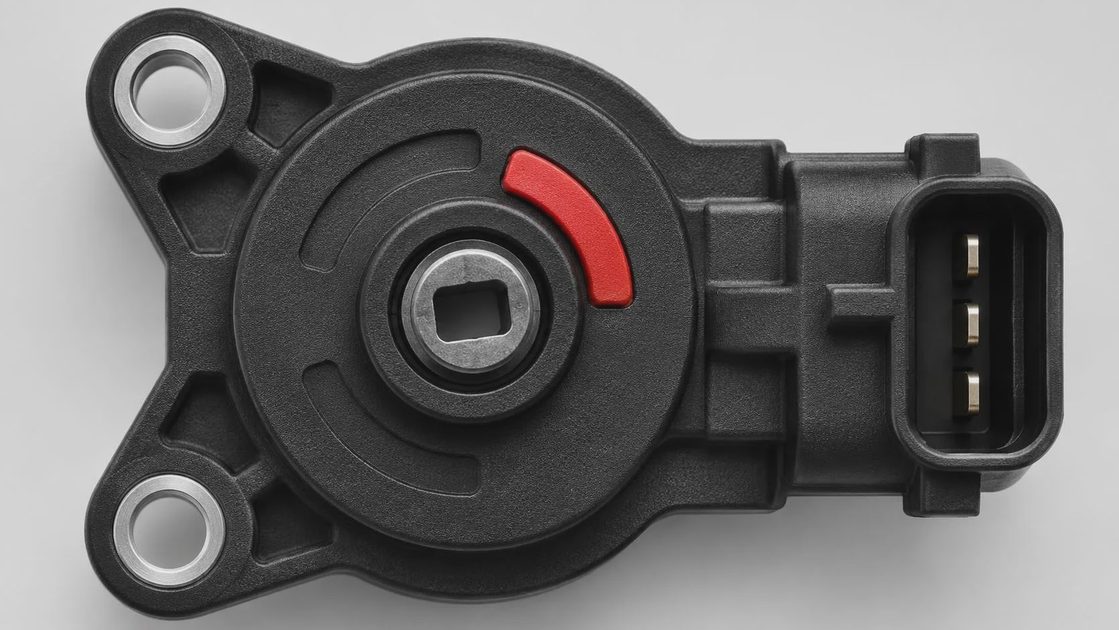
Mounted on or near the throttle body, the throttle position sensor reports throttle-blade angle to the engine control module. On many older systems, it uses a potentiometer: a wiper moves across a resistive track as the throttle shaft turns. Newer vehicles may use dual Hall-effect or magnetic sensors for redundancy, but the control unit still needs a reliable representation of driver demand.
A typical five-volt reference circuit has a ground, a reference supply, and one or more signal wires. With the throttle closed, the signal might be around 0.5 volts; at wide-open throttle, it may approach 4.5 volts. Those are common design values, not universal specifications. The repair manual for the exact vehicle is the authority.
Reference Box: The throttle position sensor is an electrical angle sensor. It does not measure fuel pressure, manifold vacuum, or engine speed. Its job is to report throttle position accurately and consistently.
When the signal is plausible, the module can calculate acceleration enrichment, deceleration fuel cut, idle strategy, and automatic-transmission shift requests. A worn sensor can therefore create symptoms that look like an injector, transmission, or vacuum problem.
Symptoms that deserve a test
A failing throttle position sensor often produces hesitation when the driver first opens the throttle. The engine may stumble from idle, surge at a steady speed, or respond normally only after the pedal is pushed farther. Some vehicles develop a high or unstable idle because the module no longer recognizes the closed-throttle position.
Other clues include harsh or delayed automatic shifts, limited throttle response, poor cruise control operation, and an intermittent check-engine light. Diagnostic trouble codes can include P0120 through P0124, although code definitions and likely causes vary by manufacturer. A code identifies a circuit or range problem; it does not prove that the sensor itself is defective.
A dead spot is especially meaningful. If the vehicle hesitates at a repeatable pedal position, the internal resistive element may have a worn section. A loose connector, damaged harness, poor ground, or carbon contamination around the throttle plate can imitate the same complaint.
How to test the circuit safely
Begin with a wiring diagram and a digital multimeter. Do not pierce insulation unnecessarily; use back-probing leads or suitable test adapters. Turn the ignition on with the engine off, unless the service procedure says otherwise. Keep hands, clothing, and tools away from the throttle linkage and cooling fan.
First confirm the reference voltage. A reading substantially below the specified value can indicate a shared sensor-supply problem rather than a bad throttle position sensor. Next check the ground voltage drop under the prescribed conditions. A high-resistance ground can distort every sensor reading on that circuit.
Measure the signal with the throttle closed and then open it slowly by hand. The voltage should change smoothly, without sudden jumps, dropouts, or a frozen value. Compare the results with the manufacturer’s closed-throttle and wide-open-throttle specifications. A scope can reveal a brief dropout that a handheld meter averages away, which is useful when the fault appears only on the road.
Do not condemn a sensor because the signal is slightly different from a generic internet value. Ford, General Motors, Toyota, Honda, and other manufacturers use different calibration strategies. Some systems also require a relearn procedure after replacement or throttle-body service.
Cleaning, adjustment, and fluid contamination
On older adjustable designs, a technician may set the closed-throttle voltage or switch position. Many modern units are not intended for adjustment. Moving the housing can create a new fault or interfere with factory calibration, so follow the service information before loosening screws.
Cleaning the throttle bore can help when deposits prevent the plate from closing fully, but cleaner is not a cure for a worn electrical track. Disconnect power as directed, use a product approved for throttle-body components, and keep liquid away from sensitive electronics. Do not flood the shaft seals or spray aggressively into a motorized electronic throttle assembly.
Engine oil mist from the crankcase ventilation system commonly leaves deposits in the intake. That does not automatically mean the throttle position sensor is contaminated. A sensor mounted externally may never contact the residue. If oil is present in the connector, find the source and inspect the seal, harness routing, and connector lock before applying solvent.
Reference Box: Automotive cleaners are not interchangeable. Brake cleaner, carburetor cleaner, and throttle-body cleaner can have different solvent strength and material compatibility. Read the label and service procedure.
Replacing the part without creating a second fault
Before replacement, record the original connector position, mounting orientation, and scan-tool data. Confirm the part number by vehicle identification number rather than relying only on appearance. Some throttle bodies include the sensor as a non-serviceable assembly; others use a separate replaceable unit.
Disconnect the battery only when the vehicle procedure permits it, because doing so can erase learned values and radio settings. After installation, inspect the connector terminals for spread pins, corrosion, or pulled wires. Route the harness away from the exhaust manifold and throttle linkage. A new part cannot correct a broken reference circuit.
Afterward, perform the required throttle or idle relearn. Some vehicles relearn automatically after a warm-up and drive cycle, while others need a scan tool. Clear codes only after recording them. Then verify cold start, hot idle, light acceleration, full-throttle response, and transmission operation. A short road test is part of the repair, not an optional extra.
A practical diagnostic example
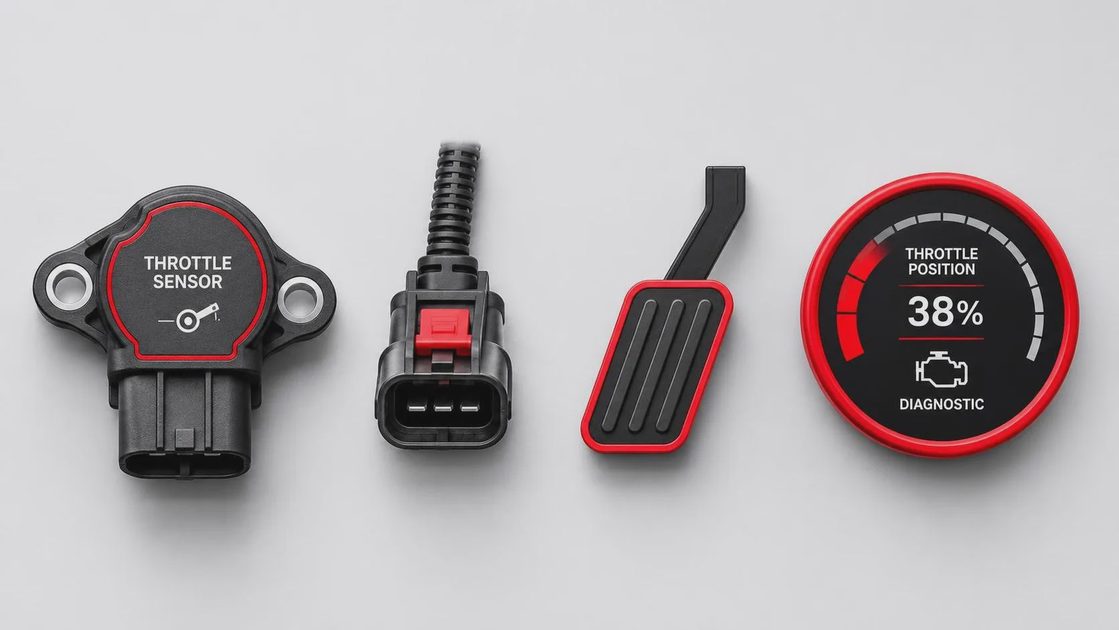
Suppose a four-cylinder sedan hesitates leaving a stop and stores a P0121 code. A parts-counter answer would be to sell a throttle position sensor. A technician’s answer is to inspect the data. If the five-volt reference is stable, the ground is clean, and the signal jumps from 0.7 to 2.1 volts when the throttle is opened slowly, the sensor or its mechanical drive is suspect.
If the signal is smooth but the module still reports implausible position, inspect the wiring and compare scan data with actual blade movement. If the blade is held open by deposits, cleaning and relearn may solve the complaint. If the reference is missing, test other sensors sharing that circuit and check for a short to ground. The correct repair could be a harness, throttle body, or control-module power supply rather than the sensor.
This approach saves the customer a needless $40 to $180 sensor purchase and prevents comebacks. Part prices vary widely, and an integrated electronic throttle body can cost several hundred dollars before labor. Testing is cheaper than guessing.
Questions to answer at the counter
Can a vehicle run with a bad throttle position sensor? Often it can, but drivability may be poor and the control module may enter a reduced-power strategy. Continued driving is not wise if throttle response is unpredictable.
Does cleaning always fix the problem? No. Cleaning addresses deposits and a sticking blade. It cannot restore a worn track, failed Hall element, damaged connector, or missing reference voltage.
Should the battery be disconnected before testing? Not automatically. Many voltage checks require ignition power, and disconnecting the battery can erase useful diagnostic information. Use the vehicle-specific instructions.
The one-line answer for a customer is simple: a throttle position sensor must provide a smooth, believable signal from closed throttle to wide-open throttle. Verify power, ground, signal, and mechanical movement before replacing it. That sequence is accurate, economical, and repeatable in the shop.

No comments yet — be the first to share a thought.