After reading this guide, you will be able to look up what P0300 means, separate an ignition problem from a fuel or mechanical problem, and choose sensible tests before replacing parts. P0300 is a generic OBD-II diagnostic trouble code for random or multiple-cylinder misfires. The engine computer has detected crankshaft speed changes that do not consistently point to one cylinder. Here's the chemistry, here's the spec, here's what to do with it.
A misfire means the cylinder did not burn its air-fuel charge normally. The cause might be weak spark, incorrect fuel delivery, an intake leak, low compression, or valve timing. Because P0300 does not identify a single cylinder, diagnosis requires evidence rather than a parts cannon approach. A flashing malfunction indicator lamp means the misfire is severe enough to threaten the catalytic converter, so reduce load and stop driving when it is safe.
What P0300 Means in the Engine Computer
The crankshaft position sensor tells the powertrain control module how quickly the crankshaft is turning. Every combustion event should add a predictable amount of speed. When one or more events fail, the computer sees an irregular acceleration pattern and counts a misfire. If the pattern cannot be assigned reliably to cylinder 1, 2, 3, or another specific cylinder, it stores P0300.
P0300 can appear alone or with cylinder-specific codes such as P0301 for cylinder 1 or P0304 for cylinder 4. It can also accompany fuel-trim codes, oxygen-sensor codes, or camshaft and crankshaft correlation codes. Record every stored and pending code before clearing anything. Freeze-frame data, including engine speed, coolant temperature, load, and vehicle speed, often tells you whether the event occurred during a cold start, acceleration, or steady cruise.
Reference Box: P0300 is a misfire-monitoring code, not a failed-part diagnosis. The code identifies abnormal crankshaft acceleration; testing identifies the cause.
A solid check-engine light generally allows a careful trip to a repair facility, but severe shaking, loss of power, fuel odor, or a flashing light calls for immediate attention. Unburned fuel entering the exhaust can overheat the catalyst substrate and turn a manageable ignition repair into a costly exhaust repair.
Common Causes and the Best First Checks
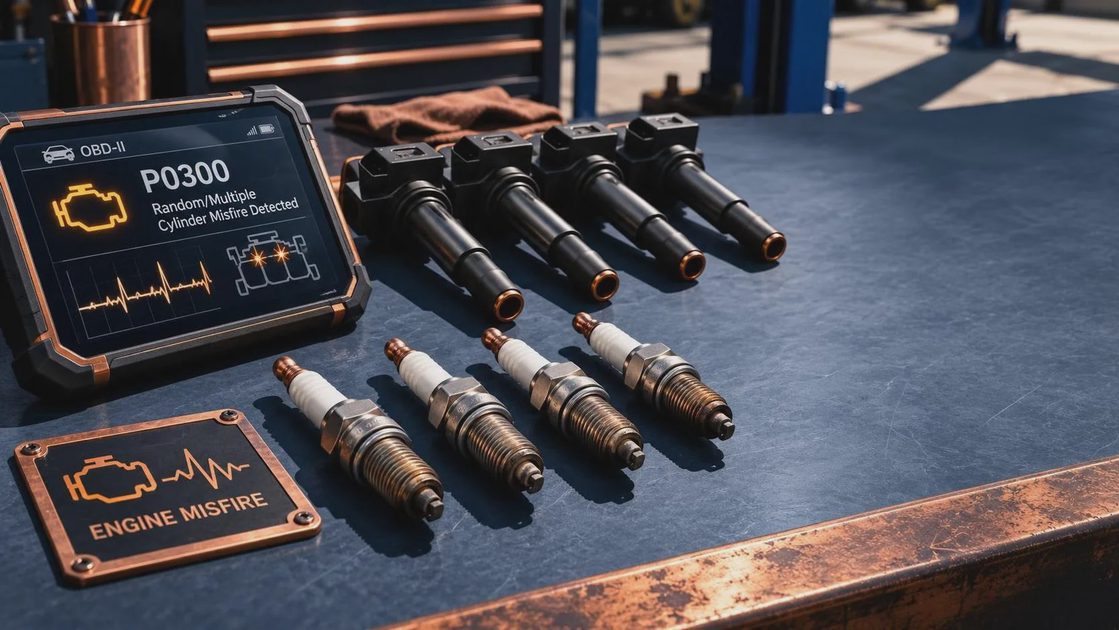
Start with service history and basic inspection. Worn spark plugs, cracked ignition-coil boots, damaged wiring, loose grounds, and oil or coolant in a plug well are common findings. If the vehicle has individual coil-on-plug units, a technician can move a suspect coil to another cylinder after a cylinder-specific code appears and see whether the fault follows it. Do not swap parts randomly when the only code is P0300; first determine which cylinder is contributing poorly.
Fuel delivery deserves equal attention. A restricted injector, poor electrical connection, low rail pressure, or contaminated fuel can create a lean misfire. Compare commanded and actual fuel pressure using the manufacturer’s procedure, not a universal guess. Short-term and long-term fuel trims are useful clues: large positive trims suggest the computer is adding fuel, while negative trims suggest an overly rich condition. A vacuum leak near one intake runner may affect one cylinder more than the others.
Inspect the air-intake duct, PCV hoses, brake-booster hose, and intake-manifold sealing surfaces. A smoke test is safer and more informative than spraying flammable fluid around a running engine. Keep hands, clothing, and test leads away from belts, fans, and hot exhaust components.
A Practical Diagnostic Sequence
Begin by confirming the complaint. Is the engine rough only at idle, only under load, or throughout the rpm range? Scan for current, pending, and history codes, then save freeze-frame data. Clear codes only after recording them, and do not erase adaptive information unless the service procedure calls for it.
Next, inspect and test the ignition system. Verify plug type, heat range, gap, and installation against the vehicle manufacturer’s specification. A plug that looks clean can still have an excessive gap or internal failure. Check coil power, ground, and control signals with the correct wiring diagram. On systems using a shared coil pack, test the secondary circuit and plug wires for excessive resistance or insulation damage.
Then evaluate fuel and air. Compare fuel pressure under the conditions described in the service manual. Listen for injector operation, inspect injector connectors, and use balance testing when available. Check for unmetered air with a smoke machine. A mass-airflow sensor contaminated by the wrong cleaner or an exhaust leak ahead of an oxygen sensor can distort mixture control, but do not condemn a sensor simply because fuel trims are abnormal.
Finally, test the engine mechanically. A compression test can reveal a valve, piston, or head-gasket problem. A leak-down test adds detail by showing whether pressure escapes through the intake valve, exhaust valve, crankcase, or cooling system. If compression is low on one cylinder, ignition and injector replacement will not solve the underlying P0300 condition.

How Oil, Coolant, and Maintenance History Fit In
Fluids do not cause every P0300 event, but their condition can provide important evidence. Oil in a spark-plug well usually points to a valve-cover or tube-seal leak, while coolant on a plug tip may suggest an internal coolant leak. Do not confuse a damp plug from over-fueling with coolant contamination; coolant often leaves a steam-cleaned appearance, but confirmation requires proper testing.
Use the specified engine oil viscosity and performance category. An incorrect oil level can affect variable valve timing on engines that use oil-controlled cam phasers, although the diagnosis should also address actuator screens, solenoids, timing correlation, and oil pressure. Sludge or varnish can restrict small control passages. Changing oil is good maintenance, but it is not a substitute for testing when P0300 is active.
Fuel quality also matters. If the problem began immediately after refueling, retain the receipt and consider a fuel-sample inspection by a qualified shop. Store fuel-system cleaners in their original labeled containers, follow the product directions, and never mix chemicals. Used oil, contaminated fuel, and solvent-soaked materials require proper collection and disposal under local rules; never pour them onto soil or into a drain.
When to Repair It and When to Stop Driving
A mild, intermittent P0300 with a steady warning light still deserves prompt diagnosis. Continued driving can foul spark plugs, dilute engine oil with fuel, reduce fuel economy, and damage the catalytic converter. A flashing lamp, severe vibration, backfiring, or a strong raw-fuel smell changes the decision: shut down the engine and arrange transportation or towing.
A parts-counter conversation should focus on testable symptoms. Ask whether the light is flashing, whether other codes are present, whether the vehicle misfires cold or hot, and whether recent work involved plugs, coils, intake components, or fuel. Those details can narrow the first inspection considerably. A professional scan tool with misfire counters and graphing capability is more useful than replacing all coils as a guess.
If your customer asks, the one-line answer is: P0300 means the computer sees random or multiple-cylinder misfire activity, and the repair depends on whether spark, fuel, air, or compression is responsible. Start with scan data and visual checks, follow with targeted ignition and fuel tests, and finish with mechanical testing when the simpler causes do not explain the evidence.

No comments yet — be the first to share a thought.