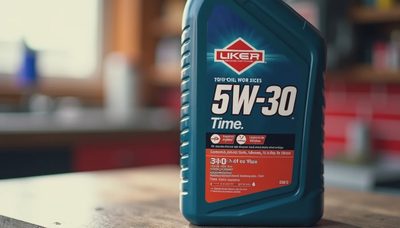
If you are looking up **5w 30 oil viscosity**, this post will let you answer three common questions fast: what the numbers mean, how the oil behaves in cold starts and at operating temperature, and when 5W-30 is the right choice for an engine. Here's the chemistry, here's the spec, here's what to do with it. For technicians, parts staff, and serious DIY owners, the goal is not memorizing a label. The goal is understanding what the grade is actually telling you under the SAE J300 viscosity standard so you can match oil to the engine and service conditions.
What 5W-30 actually means
The short answer is that 5W-30 is a multigrade engine oil. The **5W** refers to low-temperature performance, with the W meaning winter, not weight. The **30** refers to the oil's viscosity range at operating temperature under SAE J300. If your customer asks, the one-line answer is: 5W-30 is built to pump and crank like a 5W oil when cold, while protecting like an SAE 30 once the engine is hot.
**Reference Box:** Under SAE J300, the first number describes cold-cranking and pumpability limits; the second number defines viscosity range at 100 degrees C and high-temperature performance.
This matters because engines do most of their wear risk at startup, before full oil film is established. A 5W grade helps the oil move faster through galleries during cold starts than a thicker winter grade would. Once the engine warms up, the oil has to maintain enough film strength and viscosity to separate moving parts in bearings, cam lobes, and ring zones. That is where the 30-grade side of the label earns its keep.
How 5W-30 behaves in the real engine
On the spec sheet, the number that decides it is not just the label on the bottle. A proper look at **5w 30 oil viscosity** includes cold-cranking simulator results, mini-rotary viscometer pumpability, kinematic viscosity at 100 degrees C, and high-temperature high-shear viscosity. Those tests are tied to ASTM methods and the SAE grading system. In plain shop language, they tell you whether the oil will let the engine turn over in the cold and whether it will stay thick enough under load when hot.
A 5W-30 oil is usually a good middle-ground grade for mixed driving: morning starts, highway operation, stop-and-go traffic, and moderate seasonal swings. That is one reason it has been a common factory recommendation in many gasoline vehicles for years. It gives solid low-temperature flow without becoming too thin for normal operating conditions.

That said, viscosity grade is only one part of the decision. The oil also has to meet the required service category and approval, such as API SP for many modern gasoline engines, and sometimes ILSAC GF-6A for fuel economy and timing-chain wear protection. Two oils can both say 5W-30 and still differ in additive package, volatility, oxidation resistance, and OEM approvals.
Is 5W-30 the same as 5W-20 or 10W-30?
No, and this is where confusion shows up at the parts counter. 5W-20 and 5W-30 have similar cold-weather behavior, but 5W-30 is thicker at operating temperature. That can mean a slightly heavier oil film when hot, though modern engines are designed around specific clearances, pump output, and fuel economy targets. If the manual says 5W-20, do not assume **5w 30 oil viscosity** is an automatic upgrade. Thicker is not always better.
Compared with 10W-30, 5W-30 generally offers better cold-start performance. Once both oils are fully hot, both sit in the SAE 30 range, but the 5W-30 reaches the critical surfaces more easily in colder conditions. That is why many manufacturers moved from older 10W-30 recommendations to 5W-30 in broad-market vehicles.
**Reference Box:** Same second number does not mean identical oil. The hot grade can match while the cold-start limits differ significantly.
If you run a fleet, this is also why consolidation needs care. One grade across multiple units can simplify inventory, but only if the engines and OEM approvals line up. The safest shortcut is still the owner's manual or fleet lubrication chart.
When 5W-30 is the right choice
Use 5W-30 when the engine manufacturer specifies it or lists it as an approved grade for the expected temperature range. That is the main rule. In many gasoline engines, especially from the 2000s through the mid-2010s, 5W-30 was a common default because it balances cold start flow, wear protection, and everyday drivability well.
It can also be a reasonable fit for some light trucks, older engines with a bit of mileage, and vehicles that see highway runs, warm-weather use, or moderate load. But the correct answer still starts with the spec sheet. Some late-model turbocharged engines need lower-viscosity oils like 0W-20 or 0W-16 for fuel economy and calibrated oil flow. Others require European ACEA or manufacturer approvals that matter as much as the viscosity grade itself.

If your customer asks whether they can switch to 5W-30 for summer only, the one-line answer is this: only if the manual allows it. Seasonal switching used to be more common, but modern multigrades and tighter OEM specs have made that less necessary.
Common mistakes, safety, and disposal
The biggest mistake with **5w 30 oil viscosity** is treating it like the whole specification. It is not. You still need the right API category, any required OEM approval, and the correct oil type for the engine, whether conventional, synthetic blend, or full synthetic. Another common mistake is mixing random leftover quarts. In an emergency top-off, mixing is usually better than running low, but for regular service, use a single correct product and viscosity.
Safety matters too. Avoid prolonged skin contact with used oil, wear gloves during service, and clean spills promptly because oily floors become slip hazards fast. Store new oil in sealed, labeled containers away from heat and ignition sources. Used oil should be drained into a clean container and taken to a recycling location; do not dump it on the ground, into drains, or into household trash. In the U.S., used oil handling is regulated, and responsible recycling is standard practice for both shops and DIY owners.
So the practical takeaway is simple: **5w 30 oil viscosity** means good cold-start flow paired with SAE 30 protection at operating temperature, but the final decision always belongs to the engine maker's specification. Read the manual, confirm the approval level, and then choose the product that matches both.